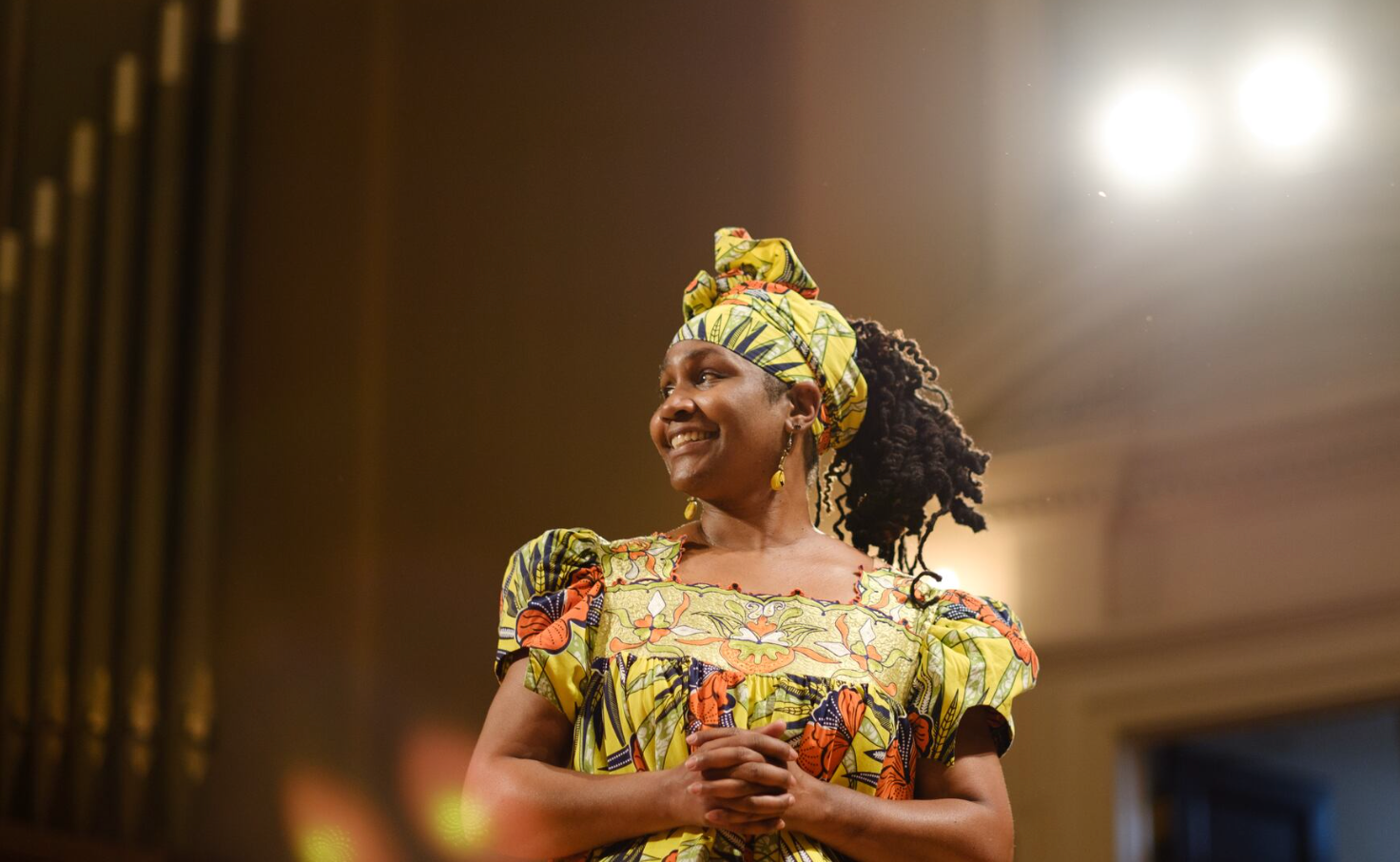
Spelman College’s Finest: The Life and Impact of Omelika Kuumba
When I arrived at Spelman last August, the first organization I was interested in was Ashietu, Sisters Chapel’s African Dance Ministry. I stayed late after service one Sunday to get more information about the Ministry, and it was then that I met Sister Omelika Kuumba for the first time. She emitted such warm and welcoming energy, further confirming that joining Ashietu would be a rewarding experience. Her calming presence and ability to push her students while remaining endlessly compassionate have consistently been a comfort as I’ve navigated the highs and lows of my first year of college.
Sister Omelika was born in Brooklyn, New York. She spent the bulk of her childhood there, living in Bedford-Stuyvesant, Clinton Hills, and Brownsville, in addition to a short amount of time in Harlem as an infant. From first through eighth grade, she attended a private school called Junior Academy, owned by an African-American couple, with an almost entirely Black teaching staff and student population. “...Growing up, we were told… if [Black people] wanted to be successful, we had to out-achieve other ethnicities because we already had three strikes against us… we had to, you know, go several extra miles. And with that in mind, we were encouraged to know that that was doable, we just had to apply ourselves.” She then attended Stuyvesant High School, one of New York City’s most prestigious specialized high schools.
Movement has been a part of Sister Omelika’s life for as long as she can remember, and as a kid, she was known for her vivacious energy and constant motion. She told me a story of preparing for a family trip and having a fever– when she slowly walked over to her mom instead of running, jumping, hopping, or skipping, her mother immediately knew she had to be under the weather. She fell in love with dance and the arts in general at a young age, taking modern classes in elementary school and African dance classes on the weekends through an organization called Black School. Black School was organized by the African American Teachers Association with the goal of exposing children to Black American culture as well as African culture. She reminisced happily on dancing with her friends when she was little, which allowed her to choreograph and sometimes teach them what she learned in her own classes. She also choreographed for a singing group she had with her cousins. “I’ve always been a mover; I’ve always enjoyed dancing and music,” she told me. “It was a part of me that still takes control of me to this day.”
In preparing to leave Stuyvesant and start college, Sister Omelika received her acceptance letter to Howard University on Christmas Eve of her senior year and was determined to attend. However, she knew she would have to apply to Spelman regardless, considering that her mom, grandmother, grandfather’s sisters, and several cousins graduated from the college. She had already submitted an application when Teresa Chandler, Spelman’s director of admissions at the time, came to New York to give a presentation. Sister Omelika was amazed, and as a result of the incredible presentation and her mother’s positive influence, she confidently committed to Spelman, a decision she will always be grateful for.
Sister Omelika had a passion for both the arts and athletics as well as dreams of becoming a veterinarian; therefore, she chose to be a physical education and biology double major. However, the components of studying physical education were very demanding in combination with the amount of lab time required for biology, so she decided to only pursue a biology degree. It was then that she faced a class many dread: organic chemistry. She struggled with formula memorization and the subject’s intangibility, and she decided science wasn’t the field for her. She found herself completely lost in what she called the “Twilight Zone," not knowing what to work towards if not the career she’d aspired to since early childhood. She then left Spelman for a year to explore new possibilities and rediscover herself. “I did a lot of studying while I was gone, just introspective stuff, a lot of spiritual studying and just growing,” she told me. “I became vegetarian and just began to really go within and see, ‘Okay, why am I here? What is my purpose in being here? And what can I do to fulfill that purpose?’”
During her break, she developed entrepreneurial skills, starting Mother Earth Jewelry with her cousin and selling pieces to AUC students outside of Clark Atlanta University. One day while selling jewelry, Sister Omelika came across a biology student she recognized who was a year ahead of her. She told Sister Omelika that biology also didn’t work out for her and that she had changed her major to philosophy. “She talked about how much she loved it because she was able to just talk and examine life through a philosophical lens. And in addition to learning what all of the different philosophers learned, and taught, and shared, she was also able to utilize what she learned and then apply it to her own thinking and her own processing.” Sister Omelika was intrigued and found the field personally relevant, considering the exploratory, inquisitive phase of her life she was in at the time. She returned to Spelman and followed that student’s path, declaring philosophy her major and falling in love with it, then graduating as a part of Spelman’s 1981 Centennial Class.
Over the course of her four years, Sister Omelika was incredibly engaged with the Spelman community, pursuing various interests and leadership roles. As a first-year, she was the president of her dorm, Chadwick Hall, and was the SGA (Student Government Association) Representative for her class. As a sophomore, she was the president of her class and pledged the Eta Kappa Chapter of Delta Sigma Theta Sorority, Incorporated. She also competed on Spelman’s synchronized swimming team and, towards the end of the year, was elected Miss Maroon and White. Her mother won First Attendant to Miss Maroon and White while at Spelman, and following in her footsteps made the pageant an even more meaningful experience.
When I asked Sister Omelika about the biggest lessons she learned from attending Spelman, the first thing she mentioned was that establishing quality relationships can help to sustain you. She spoke of the drastic transformations she underwent during college, changing her eating habits, lifestyle, and even her wardrobe, dressing more Afro-centric, or what was simply “less European and less dressy” during that time. “I was just dealing with… a different kind of consciousness…because I had established really quality relationships, the people who really were with me, stayed with me through the transition to becoming eventually the person that you see now,” she said. She talked about making especially beautiful and strong connections with people in the Spelman community, as well as at Morehouse College and Clark Atlanta University. “I've been out of school for almost 42 years, and there are people that I can pick up the phone [to call] now, and they’ll be there for me.”
In addition to the amazing people she’s met, she emphasized the positive impact of Spelman’s fundamental values and goals. One of these is strength in one’s identity and the development of self-love and confidence for Black women. “Being in spaces like Spelman helped to sustain and magnify even what it’s like to be a black woman, to be a woman in this skin and to be empowered with that, and standing in that with a sense of strength and self-knowing confidence that I bring something very valuable to the table,” she said. “And that if I'm not welcome at that table… either I can build the table myself, or I can have the tools of being able to locate other people who can help build that table for us to sit at, and make positive viable contributions.” Lastly, Spelman constantly emphasizes the importance of sisterhood, scholarship, and service, which are central to its founding. She spoke about the value of academic excellence and not being arrogant about one’s education but instead using knowledge to bring something valuable to the table in being a servant to others.
Sister Omelika has stayed true to her love for music throughout her life. She started learning how to drum at the age of 29, in addition to developing her singing abilities. She spent a few years as a background vocalist for a new-age, spiritual music group called S.O.L.A.R. (Source Of Life Archestral Revelation) and also sang for a reggae group called Monty Montgomery and the Aposse. She started her own band called Soaring High, a project she first took up in early 2020, but that was unfortunately halted by the COVID-19 pandemic before they could perform. The death of her father in November 2020 also slowed her progress, but that next month, Sister Omelika got a call that she felt was a gift from her dad, a push to keep going. She learned that the Alliance Theatre was putting together a series of performances for Atlanta artists suffering during the pandemic, all outdoors and socially distanced. The show was a huge success, and people began encouraging Sister Omelika to record an album. She started the project and created a GoFundMe in July 2021, only for her mother to pass unexpectedly that same month. Before her passing, Sister Omelika had talked to her mother about the difficulties she was having raising money, and her mother assured her that she would have everything she needed in the end. In using her mother’s phone after her passing to contact family members, she saw that almost every last text message her mother had sent included the GoFundMe link. Fortunately, Sister Omelika met her fundraising goal. “Even in transition, she was making sure that everything I needed, I would have,” she said. “Now, being able to have my music that I have created be performed by phenomenal artists is just, you know, such a blessing… And I feel my parents’ ethereal support of the work that I do. They were both very supportive of my creativity… And now, here on the other side of it, I still feel their presence and their encouragement.”
Aside from teaching dance at Spelman, her other dance endeavors have included being a part of Faiza!, the first professional company she danced with, and the Dunham Collective. She taught dance and drummed for a children’s company called Barefoot Ballet Children’s Dance Ensemble, as well as the adult company Barefoot Ballet Manya. She is a founding member of Giwayen Mata, “an all-sistah dance, percussion and vocal ensemble”, and served as its artistic director for 25 years. She has also taught African dance at AileyCamp, a summer program run by the Ailey School, and plans to do so again this upcoming summer. Sister Omelika’s main dance project right now is Metropolitan Atlanta African Dancers and Drummers.
She began her Spelman teaching journey in 1998, this past January marking the completion of her 25th year. Naturally, I wanted to know more about what’s kept Sister Omelika here so long. “It is such a special place; I was talking to someone the other day about… how fortunate I’ve been to be in a self-affirming environment,” she said. “I don’t really have to put on a mask, I don’t have to do any code-switching or any of those other things, I get a chance to just be me, do me, and share my being with scholars.” After spending a significant amount of time teaching, she’s been able to watch her students pursue all kinds of career paths, becoming doctors, lawyers, judges, and more. Some have achieved amazing heights in the arts, dancing on Broadway and appearing in television shows and movies. “That is exciting, to know that I just poured a little, a little something into them and that they touched me as well,” she said proudly.
Teaching dance has also helped Sister Omelika through difficult times, most notably when she lost her grandfather and aunt within weeks of each other. “Ashietu started in 2005, and it was in that fall, the same semester that Ashietu started when I lost two very, very significant people in my life… working with my regular students in my classes and then Ashietu was just like the salve on a wound…” she reflected. “Because I’m sharing my joy with the students, being able to have a sense of reciprocity, knowing that people are there for me, my students are there for me… has definitely helped to make me look forward to coming to work.”
Sister Omelika has two children, both of whom are also multitalented, accomplished HBCU graduates. Her son Akumba Ashanti, a Morehouse alumnus, is a drummer and owner of a construction company. He frequently drums for Sister Omelika’s classes at Spelman and for Ashietu. Her daughter Zanaida Wakatama, a Morgan State alumna, is an accountant, dancer, educator, choreographer, and cultural arts event organizer. When I asked Sister Omelika about the impact that she wants to have on others in her lifetime, she expressed the following: “When people think about me, I want them to remember the joy that we share with each other… when they think about me, I want them to feel good… I would like for people to be inspired to be the best that they can be,” she said. “I want my being to be a way of serving others, whether it’s through art, whether it’s through creativity, whether it’s through laughter… But you know, just knowing that there is a reward that you don’t have to wait for in paradise… when you serve others, there’s a blessing that comes in that moment in that time. And that the more you can give, the more you are inspired to share and serve. It can create a ripple effect. Other people want to do it, and then you just pass it on, pass it on. So those are basically the things that come to my mind first, that, ‘She made me laugh. She made me happy. And she helped me to see my own beauty, my own greatness. And she inspired me to want to share that with others.’”
If you would like to see Sister Omelika Kuumba’s work, make sure to attend 25 Years: A Celebration on May 3rd in Sisters Chapel, which will feature Ashietu’s current members as well as Ashietu alumni!
Post a comment